Pop Sculpture

Zine Scene: Pop Sculpture

Tim Bruckner, Zach Oat, and Rubén Procopio: Pop SculptureTim Bruckner, Zach Oat, and Rubén Procopio: Pop Sculpture (Watson-Guptill, 10/19/10)

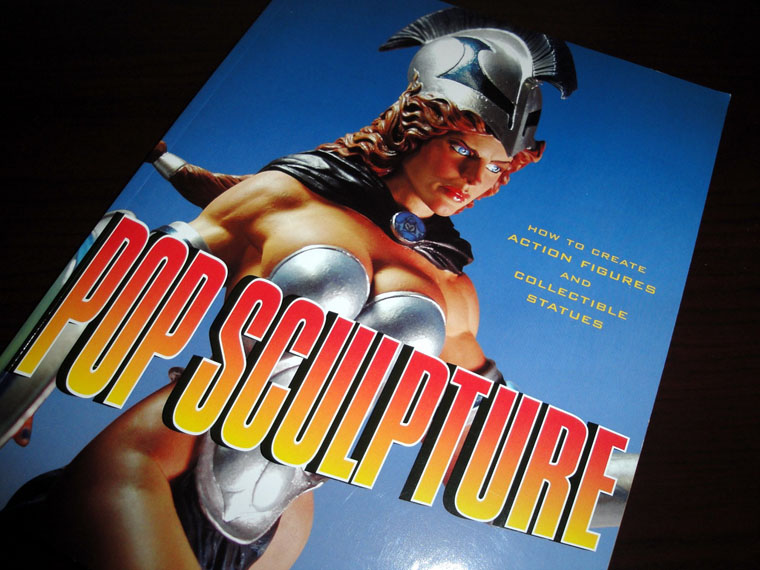
Action figures, to most of the world, are toys. To some fans or collectors, they’re a curio or a commodity, like baseball cards or commemorative plates. For the authors of Pop Sculpture, however, they are so much more. Pop Sculpture is a guide for the confused and curious, meant to inspire an interest in making your own designs, but it is also an argument that action figures are not toys, not commodities, but art.

Tim Bruckner, Zach Oat, and Rubén Procopio worked with Disney and DC Direct to reveal the secrets of designing, creating, and selling your own action figures (not dolls, they insist). Although Pop Sculpture is, first and foremost, a practical guide for the career-minded sculptor (and a great asset for those readers), it’s a treat for the casual collector or fan as well. As a degraded and commercialized art form, figure-making is rarely explored and explained in as much depth as it is here. The curtain is drawn back, and the process is revealed to be far more difficult than it previously seemed.

Pop Sculpture details the lengthy process of making action figures through the examples of a statuette-style Athena and a more familiar, pose-able Thor figure. Design and molding are described in easy-to-understand terms, with diagrams, cut doodles, anecdotes from the authors, and tips from pros along the way. Although the focus is mostly on comic-book characters and superheroes, you get the feeling that these techniques could be applied to a variety of models (in fact, some of the authors’ examples feature original characters with a more high-art bent).
Erick Lyle

Zine Scene: Scam

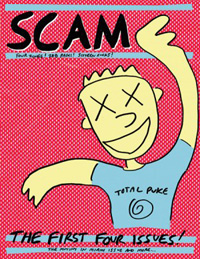
Erick Lyle: ScamErick Lyle: Scam (Microcosm, 7/1/10)

Erick Lyle, a.k.a. “Iggy Scam,” has made a living out of living for free (and teaching others how to do it too). Since 1991, when he distributed the first issue of Scam in any way that he could — appropriately enough using stolen postage stamps and mail scams — Lyle has shown punks the possibilities of squatting, stealing, and resisting the restrictions of capitalist, corporatist America. The first four issues of Scam are now available in a hefty, polished paperback volume from Microcosm, ready for a new generation of punks to carry on the fight.

Based on his experiences of living in a shared “punk house” in Fort Lauderdale, Florida, and later squatting with girlfriend Ivy in Miami, Lyle has collected a lot of knowledge and stories about dumpster diving, spray painting, shoplifting, and avoiding cops. Scam is incredibly dense and referential; most of it is handwritten in various stages of legibility, and it seems to be directed almost exclusively at the early ’90s Floridian reader. But its stories of free and (not so) easy living will be compelling for anyone who has ever thought of rejecting society’s rules and dropping out of the system.

Like any zine, there are letters to the editor — or more often, reprinted court summons — as well as book and music reviews, comics, and short stories. Accounts of scams done well and scams gone awry are balanced with a good amount of practical advice. By now, most of the scams are outdated; this was 1991, when UPC barcodes were just coming into their own, and many stores didn’t bother with entryway scanners.

Zinester's Guide to NYC

Zine Scene: Zinester’s Guide to NYC

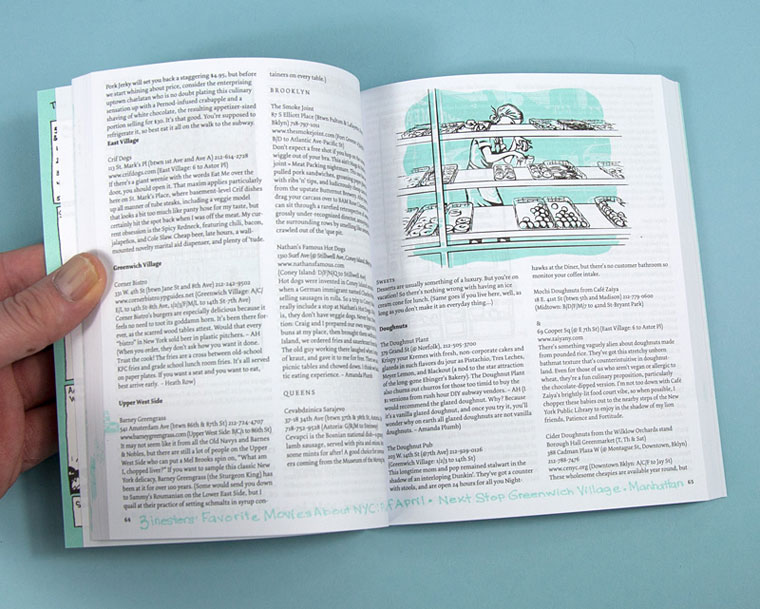
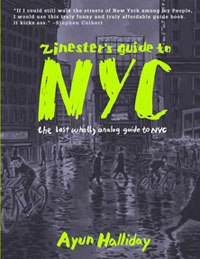
Zinester's Guide to NYCAyun Halliday: Zinester’s Guide to NYC: The Last Wholly Analog Guide to NYC (Microcosm, 11/1/10)

The Zinester’s Guide to NYC claims to be “the last wholly analog guide to NYC,” but more importantly, it’s a wonderful corrective to the Fodor’s and Frommer’s of the world.  Chock-full of secret spots, advice, and things to see and do and eat, Zinester’s Guide is truly like having a best friend (or several dozen of them with competing viewpoints) show you around their native boroughs.  Edited by Ayun Halliday (of East Village Inky fame) and created with comics, suggestions, and submissions from more than 50 other zine writers, Zinester’s Guide is an amazing amalgam of personal stories, rants and raves, and more.

Deeply familiar with where to go (and, more importantly, where not to), these natives know the city like no one else, as evidenced by a description of Art Bar in Greenwich Village: “This place is stellar.  It’s not a scene bar.  The wait staff is helpful and attentive.  The back room, complete with fireplace, feels like someone’s basement.  The Last Supper painting, featuring Jim Morrison as Jesus, is intriguing. – Heath Row.”  This book truly seems like it would help the novitiate find places and things to do that they never would otherwise.

Gutbucket

Guest Spot: Gutbucket explains how to argue about food

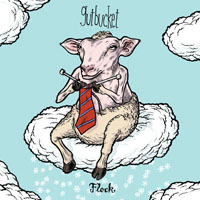
GutbucketGutbucket: Flock (Cuneiform, 2/22/11)

Gutbucket: “4 9 8”

[audio:https://alarm-magazine.com/wp-content/uploads/2011/02/03-4-9-8.mp3|titles=Gutbucket: “4 9 8”]

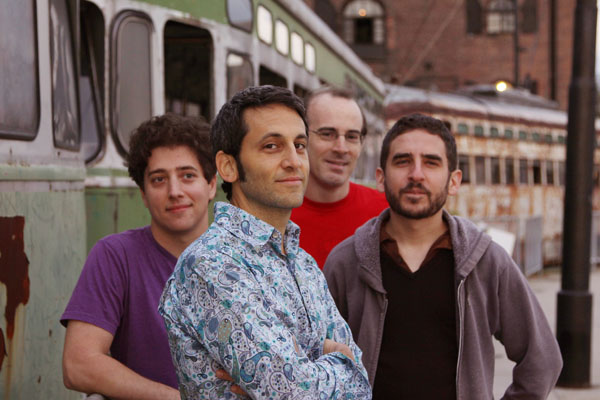
Brooklyn-based jazz-rock quartet Gutbucket released its fifth album, Flock, in February on Cuneiform. The band takes its name from the term “gutbucket,” which means to play jazz in a particularly exuberant or expressive style, and it claims that its unconventional style has been “injecting a shot of glorious spazmitude into the minimalist cool of the New York downtown scene” for the past 10 years.

Gutbucket’s off-the-wall music is the result of its members’ distinct contributions and, inevitably, artistic disagreements and compromises. When it comes to food, Gutbucket engages in a similar, hotly contested discourse. So whet your appetite and embrace the taste-bud-inspired tongue lashings with Gutbucket’s culinary treatise, “How to Argue About Food.”

How to Argue About Food
by Gutbucket

Most bands break up. It’s a fact. Rock bands do this quite a bit, and it’s often not very friendly. Jazz bands might be a bit more civil about it, or perhaps not. If you’re reading this, chances are you’ve been in a band before, so this is not unfamiliar terrain.

Take three or more humans engaged in a creative endeavor, and ideas, visions, aesthetics, and more will clash. So how do you handle this?

Well, Gutbucket has the answer.

Forget about consensus. Don’t pretend you will agree. Embrace the friction, disagreement, discomfort, and argumentative spirit.

But please have other outlets and arenas besides your music in which to behave this way.

That’s why Gutbucket chooses to argue, debate, dissect, and regularly disagree about food. Yes, food. We are a band of music nerds who spend most of our time talking about food instead of music.

Alela Diane

Guest Playlist: Alela Diane’s songs to pack a suitcase to

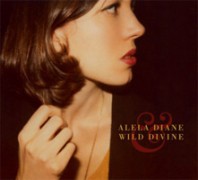
Alela Diane: Wild DivineAlela Diane: Alela Diane & Wild Divine (Rough Trade, 4/5/11)

Alela Diane: “To Begin”

[audio:https://alarm-magazine.com/wp-content/uploads/2011/05/tobegin.mp3|titles=Alela Diane: “To Begin”]

On “Pieces of String,” a track from Alela Diane‘s 2004 record, The Pirate’s Gospel, she sings, “If I had one, I’d play this on piano.” Consider it wishful thinking. Whereas her first few albums, including the self-released Gospel and Forest Parade, are characterized by spare, plucked guitar and airy harmonies about simpler times, Alela Diane‘s newest, Alela Diane & Wild Divine, stretches its legs with a greater sonic palette and higher production value. Despite the warmth and homeliness of her folk tunes, Diane’s a troubadour, and she’s got the playlist to prove it.

Songs to Pack a Suitcase to, with Anticipation for the Highway
by Alela Diane

1.  Fairport Convention: “Farewell, Farewell”

A song of goodbye.

Nine Gallons

Zine Scene: Susie Cagle’s Nine Gallons

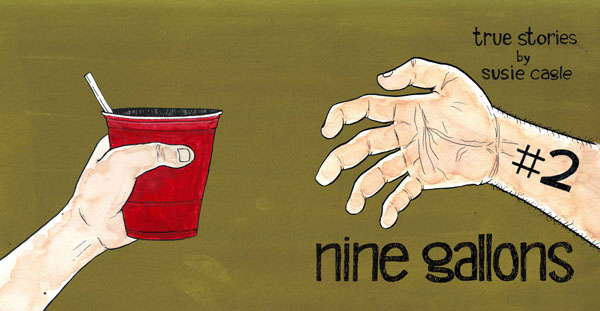
Nine Gallons Susie Cagle: Nine Gallons #1 & 2 (Microcosm)

We all want to make a difference in the world. Susie Cagle, the graphic journalist of Nine Gallons, rightly addresses the complexity and contradictory nature of this desire — and the joys of fulfilling it. Even when we help others, our motives will be questioned. We’ll wonder if we’re doing enough and then if we’re doing too much. Through her work with volunteer-based organization Food Not Bombs, Cagle’s encounters with other workers and the homeless of San Francisco (who are really just “camping”) show the difficulties of changing the world and articulating to yourself what that means.

Nine Gallons

In both issues of Nine Gallons (the first is available on Cagle’s website, the second from Microcosm Publishing), the author faces opposition from her friends, who don’t see the value of her work, and from the homeless, who are suspicious of her motives.

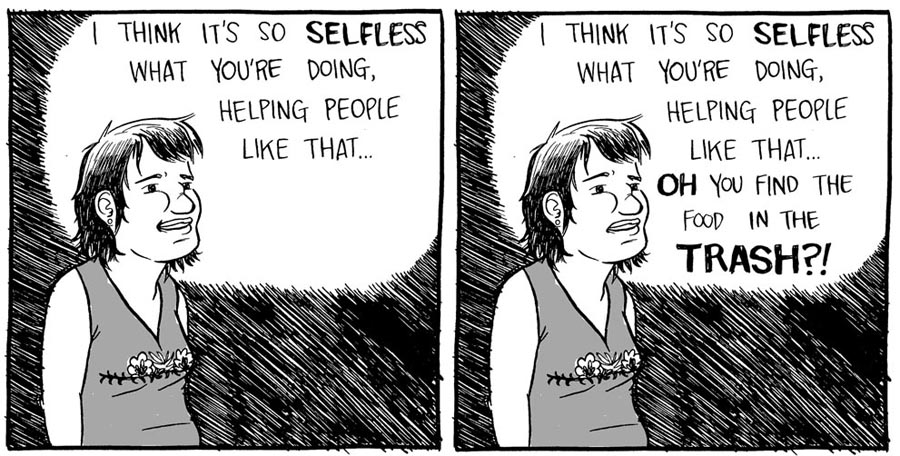
Food Not Bombs, the group that Cagle works for, scavenges ingredients from dumpsters and then makes them into soup to give to homeless people. The opening page of the second issue underscores how Food Not Bombs is seen in the community (one man assumes they’re anarchists, another insists that they shouldn’t serve vegan only, and a woman is interested until she hears that the food is scavenged from the trash). Already, we see that an organization that is ostensibly selfless and helpful to the community is subject to scrutiny from that same community — all because its motives and selflessness seem suspect.

Antenna Gallery

Gallery Spotlight: Antenna Gallery

During the summer of 2005, New Orleans resident Anne Gisleson and her friends were in the midst of developing Intersection New Orleans, a collaboration that encouraged 25 pairs of artists and writers to find inspiration in 25 intersections throughout the city. After Hurricane Katrina ravaged the city, Gisleson and her friends were determined to regroup and continue providing a cultural refuge for locals.

“It was just kind of an imperative need to start doing things after the storm, because nothing was happening culturally, for obvious reasons,” Gisleson says.

The informal art shows and literary events that the group hosted in the months after the storm led to the formation of Press-Street later that year. In 2008, Gisleson and her partners opened Antenna, a gallery space on St. Claude Street in the city’s Upper Ninth Ward. Their intent with Antenna was to create a place that would support and inspire the local creative community by focusing on cutting-edge contemporary art.

“It’s a space where the commercial end is taken out of the equation,” Gisleson says. “It’s a space where people can do the sort of projects that they wouldn’t be able to do in a for-profit gallery, which tends to be a bit safer and market oriented.”

Antenna Gallery

Gingerbread Girl

Zine Scene: Gingerbread Girl

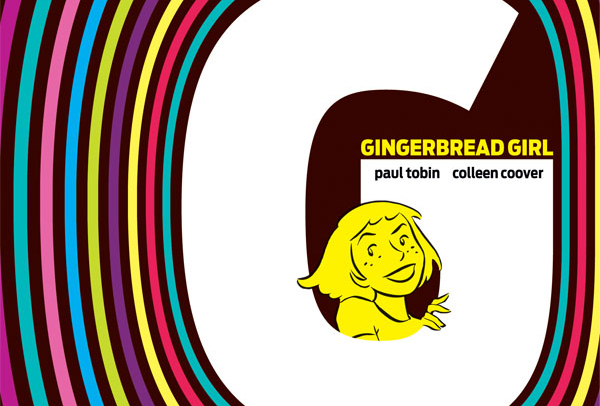
Gingerbread GirlPaul Tobin & Colleen Coover: Gingerbread Girl (Top Shelf Comix, 7/7/11)
Annah Billips is one strange girl.  A self-described tease, she flirts and dates, has boyfriends and girlfriends, and apparently can’t fall in love for one very strange reason: her mad-scientist father removed her Penfield homunculus when she was nine years old, and it became a clone named Ginger who ran away with Annah’s ability to feel strong emotion.  Or did it?

Gingerbread Girl, the new graphic novel by husband-and-wife team Paul Tobin and Colleen Coover, boasts a bizarre storyline that runs the strong risk of alienating some.  Self-consciously odd and full of narrative daring, the comic has its own charms, though, and an adventurous reader can’t help but be drawn into its central mystery.  Does Annah really have a twin named Ginger walking around, or is she actually crazy and deeply scarred from her parents’ divorce years before?

Gingerbread Girl doesn’t give any answers, but it does take a fascinating journey through Annah’s psyche, as seen by lovers, bystanders, pigeons, bulldogs, a neuroscientist, and a magician.

Tobin chooses to tell Annah’s story via a fluid stream of narrators, each of whom speaks directly to the reader and then passes the story amongst the other narrators. How each speaker chooses to define Annah, or judge her sanity, gives us a little insight into the narrator. As the reader follows Annah on a date with her girlfriend, Chili, Tobin wisely leaves Chili’s perspective for last.

Extra Extra Gallery

Gallery Spotlight: Extra Extra

When Dan Wallace, Derek Frech, and Joe Lacina started Extra Extra in 2009, they had relocated to Philadelphia and were discovering the city’s growing art scene.  The three initially met at the Maryland Institute College of Art and planned to eventually open an art space.

“Initially, a lot of people were interested [in starting a space], but then it just dwindled down to the few that were actually devoted to it,” Wallace says. “So we moved to Philadelphia with the intention of starting a space.”

Extra Extra Gallery

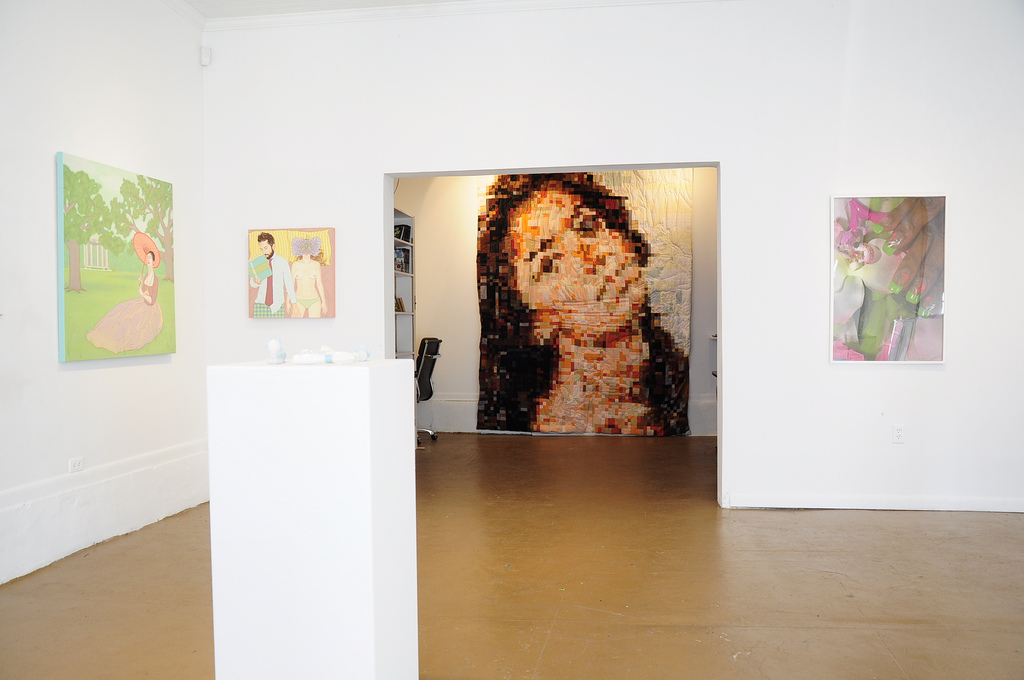
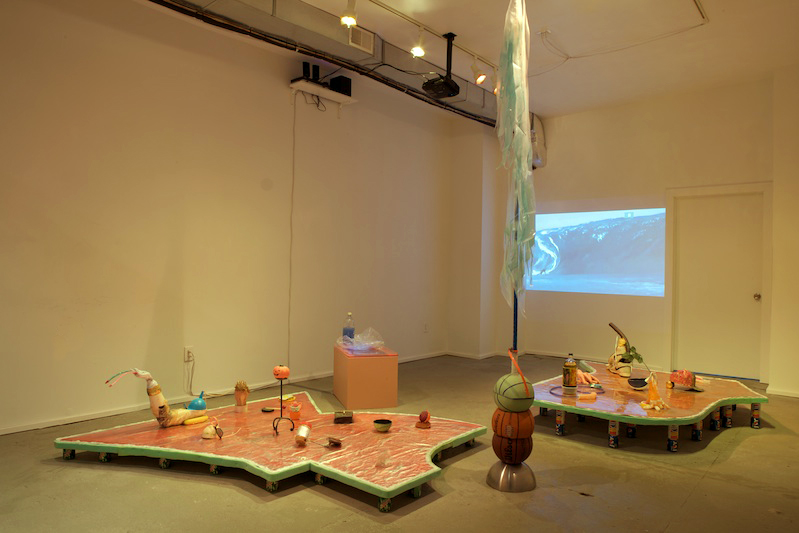
Extra Extra is one of a handful of artist-run spaces in Philadelphia. Wallace, Frech, and Lacina wanted the space to provide a platform that would allow artists to create work that could challenge the traditional notions of what art, an artist, or a gallery could be.
 

Extra Extra Gallery
Jon Rafman and Tabor Robak's "BNPJ.exe"