


Zu

Zu: Plumbing the Depths of Sludge Jazz

On its 2009 album, Carboniferous, Italian sludge-jazz trio Zu manages to get even heavier with piles of effect pedals and Mike Patton‘s wild vocal gymnastics.

Tennis

Pop Addict: Tennis’ Cape Dory

Tennis: Cape DoryTennis: Cape Dory (Fat Possum, 1/18/11)

Tennis: “Long Boat Pass”

[audio:https://alarm-magazine.com/wp-content/uploads/2011/02/Tennis-Long-Boat-Pass.mp3|titles=Tennis: “Long Boat Pass”]

Fiction is at the heart of pipe dreams. Rarely when we scheme something far-fetched or grandiose do we actually follow through in executing our plan, especially if it’s something as profound as selling all of our possessions and sailing across the map for about a year or so. But that is precisely what husband-and-wife duo Patrick Riley and Alaina Moore, the masterminds behind indie-pop outfit Tennis, did.

After graduating from college, the two philosophy majors sold their belongings and ventured away from Denver to embark on the unknown by means of a sailboat — a plan for which they prepared extensively. Navigating around North America, the couple then decided to document the experience, not through film or memoir, but through music. And thus Tennis was born.

From the get-go, Cape Dory, the couple’s debut effort on Fat Possum, gives you a glimpse of what its voyage must have been like. With 10 songs clocking in at less than 30 minutes, Riley and Moore’s feeling of staying put for too long in any one place is almost tangible. Once the album sets sail, it’s ready to move along without the need of staying anchored in any one spot. The songs, with titles like “South Carolina,” “Baltimore,” and “Bimini Bay,” move along swiftly, as the band looks to cover the most ground (or water, rather) in the quickest amount of time.


World in Stereo: Kodo’s Akatsuki

Each week, World in Stereo examines classic and modern world music while striving for a greater appreciation of other cultures.

Kodo: Akatsuki (Otodaiku, 1/11/11)

Kodo: “Stride”
[audio:https://alarm-magazine.com/wp-content/uploads/2011/02/Kodo_Stride.mp3|titles=Kodo: “Stride”]

In the Niigata prefecture, 32 miles west of Honshu in the Sea of Japan, is an island widely known as a place of exile.  The remoteness of Sado Island made it a site for banishment until the 1700s, a punishment second only to death for those poets, dramatists, and even emperors who were seen as disgraces to their country.  But its isolation has also made it one of Japan’s unspoiled beauties, an island of dramatic precipices and remarkable ravines crowned by two parallel mountain chains.

The island is where, 30 years ago, Kodo was established not only as a Japanese performing arts troupe, but as a village sharing a very distinct collective lifestyle.  Preserving and revitalizing the art of the taiko (traditional Japanese drum), Kodo has been fusing high-energy percussion, elegance, and traditional dance for over three decades.  Since debuting at the Berlin Festival in 1981, the collective has given thousands of performances on five continents.  Kodo’s new album, Akatsuki, celebrates its thirtieth anniversary with brand-new compositions and never-before-recorded stage pieces.

The Kodo collective is always constant, never stagnant.  The almost 50-member collective lives in Sado Village, a 32-acre plot of land established in 1988.  Including staff members, performers, seniors, and apprentices, the group shares the same lifestyle: living, eating, creating, and rehearsing.  As the oldest members turn 60 and the youngest apprentices 20 this year, it’s an evolving cast of players, a natural transference not only skills and techniques, but also ideologies and culture.

Morrow vs. Hajduch

Morrow vs. Hajduch: The Mag Seven’s Black Feathers

Scott Morrow is ALARM’s music editor. Patrick Hajduch is a very important lawyer. Each week they debate the merits of a different album.

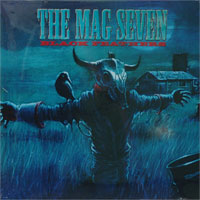
The Mag Seven: Black Feathers

The Mag Seven: Black Feathers (End Sounds, 11/16/10)

The Mag Seven: “By the Time I Get Out of Phoenix”
[audio:https://alarm-magazine.com/wp-content/uploads/2011/02/The_Mag_Seven_By_the_Time_I_Get_Out_of_Phoenix.mp3|titles=The Mag Seven: “By the Time I Get Out of Phoenix”]

Morrow: Over the course of a dozen years and a half-dozen releases, The Mag Seven has traversed surf rock, Italian western, punk, rockabilly, guitar-centered jazz, and more.  Originally configured with True Widow and Slowride guitarist Dan Phillips, the group shifted its sound in the mid-2000s with the addition of guitarist Brandon Landelius, and the decision was fruitful.

Black Feathers is the group’s new seven-track vinyl/digital EP — its fourth album with Landelius and sixth overall.  It’s charged with the same surf-rock energy of albums past but scales back the jazz leanings and Angelo Badalamenti-style moodiness of its last release, Cotton Needle Sessions.  Though short, it’s a well-balanced release, alternating between the down-tempo swagger of “Jive Turkey,” the reverberated rock of “My War,” and the western dub of “By the Time I Get out of Phoenix.”

Night Animals

Zine Scene: Night Animals

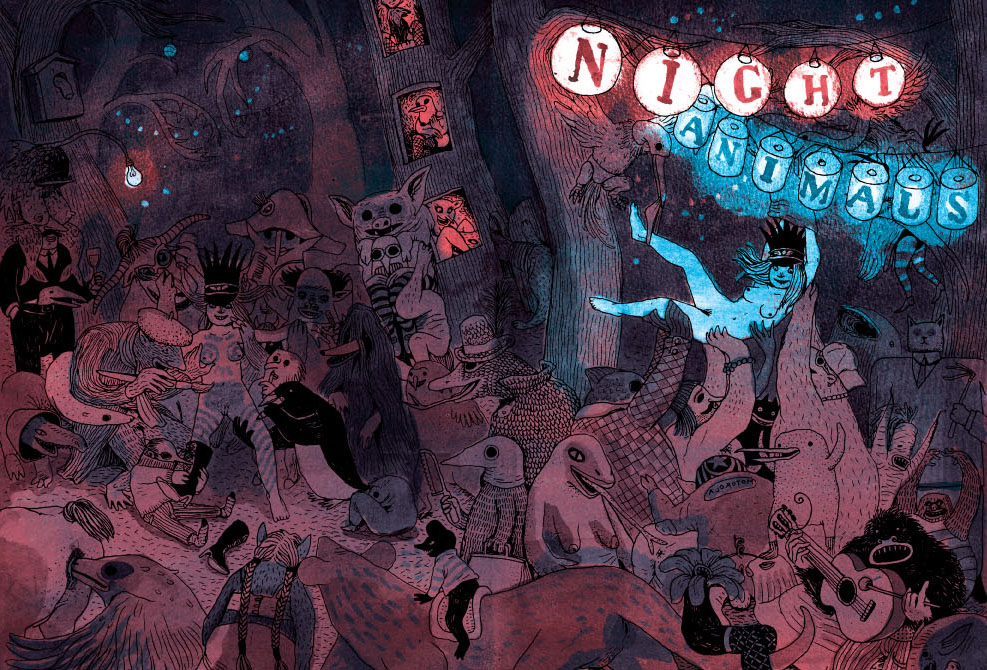
Night AnimalsBrecht Evens: Night Animals (Top Shelf, March 2011, $7.95)

Equal parts Edward Gorey and Where the Wild Things Are — surreal and yet completely honest — the newest work by Belgian graphic novelist Brecht Evens makes one hell of an impression without saying anything at all.

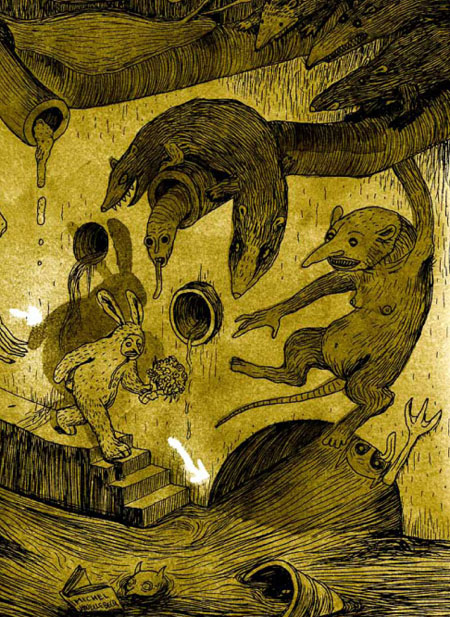
Night Animals, described on its title page as “a diptych about what rushes through the bushes,” charms with two very different wordless stories. In the first, a man waits to meet a blind date and is compelled to search for her through the sewers and underground, encountering a vast array of monsters that live there on his way. The second follows a young girl as she undergoes puberty (all in one day) and is later kidnapped by similar monsters for a wild party in the woods that soon turns sinister.

The first story, “Blind Date,” playfully recasts the uncertainty of waiting for an unknown woman into an epic quest involving sewer diving, spelunking, and fending off various beasts. Ultimately light and funny, it contrasts sharply with the second story’s comparative darkness. In “Bad Friends,” a young girl gets her first period during the school day, and while feeling ashamed later at home, is carried off by monsters. A bacchanal ensues in the forest, celebrating her new-found womanhood, but the monsters’ dark intentions leave the reader with a final sense of dread.

It seems fitting to use the word “phantasmagoric” for Evens’ sprawling, intricate visuals, considering his debt to the many artists that the label has also been applied to, and his obvious debt to most of them. His pen drawings obviously recall Gorey, as mentioned, or Tim Burton’s doodles, and even some more creative children’s books (although a celebration of a young woman’s first period would likely not be found in most of those).

Night Animals

Lissie

ALARM Dispatches: Lissie

Elisabeth Maurus, better known under her stage name Lissie, returns to her home state of Illinois for a show and reflects on the changes that have come with success.

Basil Kirchin

The Groove Seeker: Basil Kirchin’s Primitive London

On a weekly basis, The Groove Seeker goes in search of killer grooves across rock, funk, hip hop, soul, electronic music, jazz, fusion, and more.

Basil Kirchin: Primitive London (Trunk Records, 12/6/10)

Basil Kirchin: “Primitive London 3”

[audio:https://alarm-magazine.com/wp-content/uploads/2011/01/03-basil_kirchin-primitive_london_3.mp3|titles=Basil Kirchin: “Primitive London 3”]

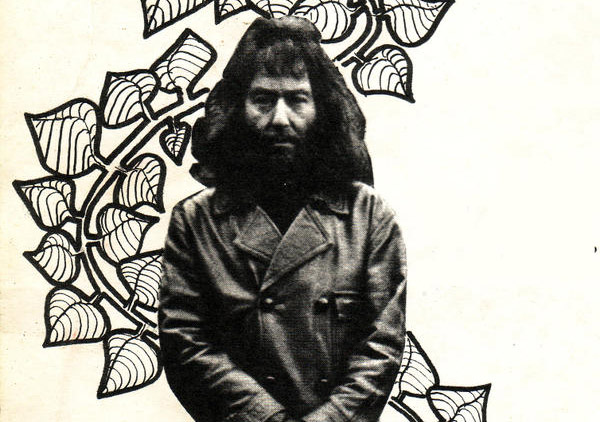
As one of the most under-appreciated artists of his time (roughly from the late 1950s to the mid-’70s), Basil Kirchin’s music has been shrouded in obscurity.  But thanks to Jonny Trunk and the folks at Trunk Records, who’ve reissued titles such as Particles and Abstractions of the Industrial North, Kirchin has not only been realized as one of jazz’s most eccentric characters, but as a musician ahead of his time in terms of experiments in sound and fusion.

Trunk Records’ latest release, Primitive London, reveals some of the grooviest music Kirchin ever made, bringing together two never-before-released film scores.  The first is the strange cult-classic Primitive London, the 1965 Arnold Louis Miller shock-doc that explores the dark side of London during its birth of cool.  Accompanying Primitive London is an even more obscure unreleased gem, The Freelance, a 1971 gangster film shot in London featuring a score by Kirchin.

Trunk Records’ decision to release them together is a fantastic idea: each film reflects two distinct periods in Kirchin’s musical career and development.  Primitive London listens like a double feature; Kirchin’s swinging ’60s jazz turns into something entirely different by the 1970s, as he delves deeper into the spontaneity of free jazz and the nuances of the experimental.

Dandelion Records & Emporium

Behind the Counter: Dandelion Records & Emporium (Vancouver, BC)

Each Tuesday, Behind the Counter speaks to an independent record store to ask about its recent favorites, best sellers, and noteworthy trends.

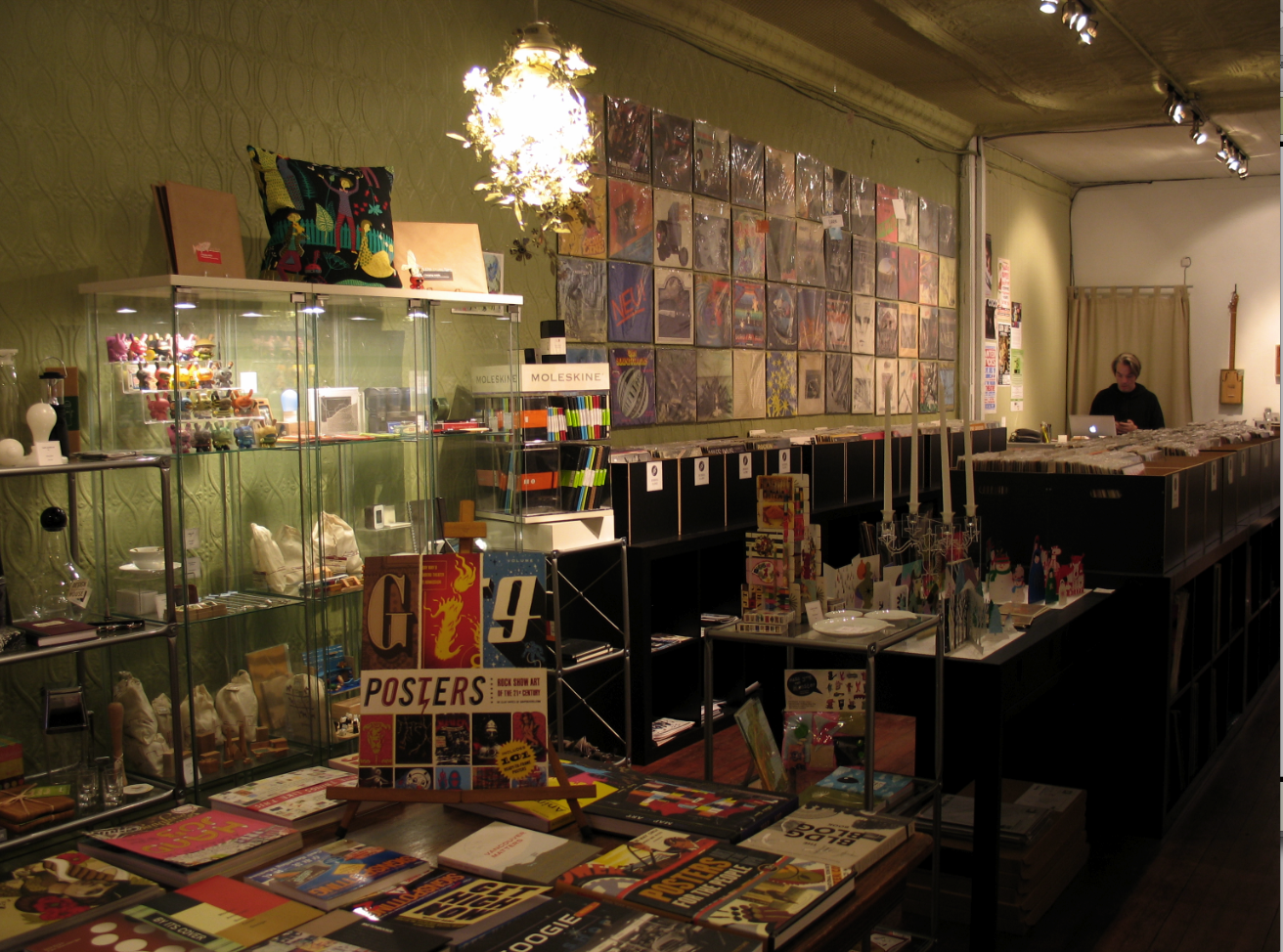
Dandelion Records and Emporium in Vancouver, British Columbia, is run by the husband-and-wife team of Jeff Knowlton and Laura Frederick. The two merged their interests in music and art to form what was formerly known as simply Dandelion Records. As they added more inventory, expanded to include goods such as books and art, and moved to a bigger location, they added “Emporium” to the store’s name. Though its name points to a massive retail experience, Dandelion offers an intimate experience with a carefully curated selection of new and used vinyl and well-designed products.It’s the sort of place Andy Samberg calls when he needs a rare record a.s.a.p.

What are the origins of Dandelion Records?

Dandelion Records and Emporium is owned by my husband, Jeff Knowlton and myself, Laura Frederick. We met in Victoria when Jeff was working as a museum exhibit designer and I was manager of a design store. Jeff was an avid record collector, and I had an interest in music and a background in retail, as well as art and design. We moved to Vancouver in 2006, and Jeff began selling records at a well-known flea market. That was the beginning of the roots of the store. In 2007 we opened Dandelion Records in the basement of a shared gallery space. It was pretty small and dingy, just the sort of place to find great records. The following year we moved into our own store space at Main and Broadway. Our vinyl selection continued to grow, and in 2008 we moved to our current location at 2442 Main Street. We expanded the store to include a selection of books, bags, stationery, and other items, and changed the name to Dandelion Records and Emporium. Jeff and I both work at the store, and currently there are no other employees.