All Tiny Creatures

Pop Addict: All Tiny Creatures’ Harbors

Every Thursday, Pop Addict presents infectious tunes from contemporary musicians across indie rock, pop, folk, electronica, and more.
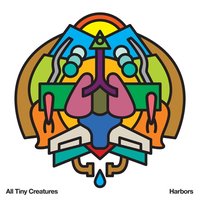
All Tiny Creatures: HarborsAll Tiny Creatures: Harbors (Hometapes, 3/29/11)

All Tiny Creatures: “An Iris”

[audio:https://alarm-magazine.com/wp-content/uploads/2011/03/AllTinyCreatures-AnIris.mp3|titles=All Tiny Creatures: “An Iris”]

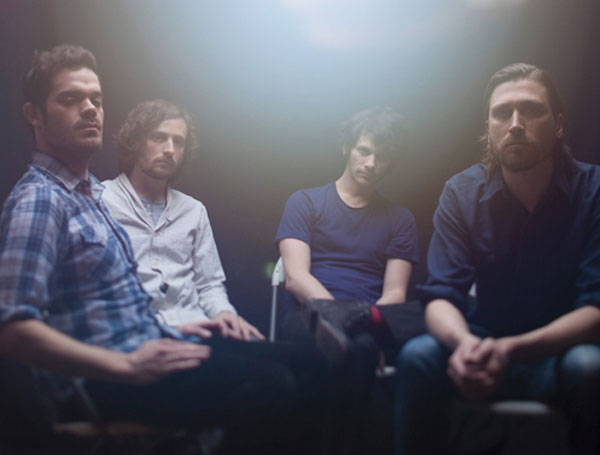
If you’re in a band from Wisconsin, and you’re friends with Justin Vernon of Bon Iver, people are going to hear about your record. And if you happen to enlist his help, if only for one track, most of those people will venture a listen or two. Make that song your single and you’ve pretty much guaranteed a modicum of favorable attention from fans and critics alike.

But if, like Madison’s All Tiny Creatures, you also happen to seamlessly weave synthesizers, guitars, and percussion into loop-heavy, pop-friendly melodies, then you’ve probably earned a great deal of that notoriety on your own; in fact, that attention might be long overdue. With or without Justin Vernon, your band is on the verge of something exciting. And you should congratulate yourself with a nice Wisconsin cheese tray.
World in Stereo: Those Shocking, Shaking Days: Indonesian Hard, Psychedelic, Progressive Rock and Funk, 1970-1978

World in Stereo examines classic and modern world music while striving for a greater appreciation of other cultures.

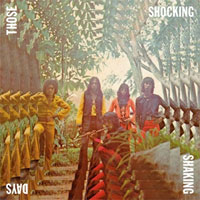
V/A: Those Shocking, Shaking Days: Indonesian Hard, Psychedelic, Progressive Rock and Funk, 1970-1978 (Now-Again, 3/8/11)
Shark Move: “Evil War”

[audio:https://alarm-magazine.com/wp-content/uploads/2011/03/04-Evil-War.mp3|titles=Shark Move: “Evil War”]

Giving service to the music and the musicophiles who go in search for it, Now-Again Records has released a stunning overview of 1970s Indonesian funk, rock, and psychedelia recordings in an anthology titled Those Shocking, Shaking Days.  The title is a perfect summation of the sounds coming from the compilation; deep funk gems and gritty rock riffs are captured in the lowest of lo-fi senses, driven to the head by relentless fuzz guitars, psychedelic howls, and all kinds of general weirdness.

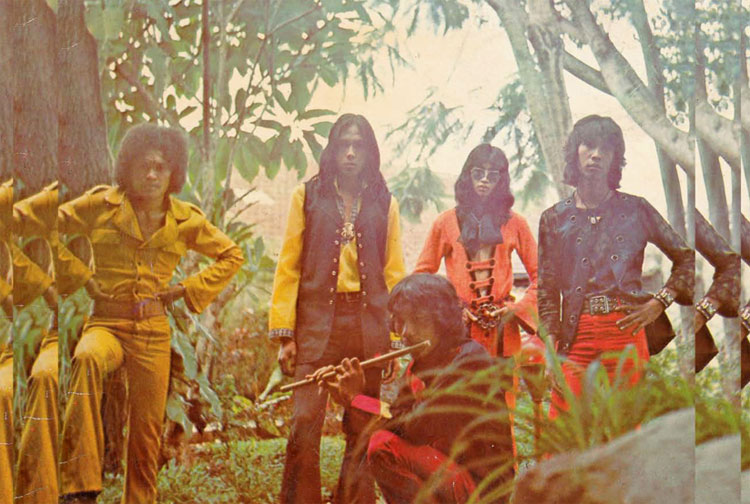
Helmed by Now-Again’s head honcho Egon, with research and crate digging from producer Jason “Moss” Connoy (and the not-to-be overlooked assistance from Indonesian rock legend Benny Soebardja, who secured all the necessary rights), the compilation is what happens when the record-collector gods align everything just right. Add in a thick booklet with groovy album art, eccentric band photos that could only belong to the ’70s, and extensive track-by-track notes from Holland-based Indonesian ex-pat Chandra Drews, Those Shocking, Shaking Days does an incredible job of giving listeners the whole package.

Morrow vs. Hajduch

Morrow vs. Hajduch: The Fun Years’ God Was Like, No

Scott Morrow is ALARM’s music editor. Patrick Hajduch is a very important lawyer. Each week they debate the merits of a different album.

The Fun Years: God Was Like, NoThe Fun Years: God Was Like, No (Barge, 11/16/10)

The Fun Years: “Breech on the Bowstring”

[audio:https://alarm-magazine.com/wp-content/uploads/2011/03/The_Fun_Years_Breech_on_the_Bowstring.mp3|titles=The Fun Years: “Breech on the Bowstring”]

Hajduch: The Fun Years is among a noticeable cadre of artists pushing icy, shoegaze-tinged ambient music these days, but the duo lacks the name recognition of Tim Hecker or even Ben Frost. Hopefully, its 2010 release, God Was Like, No, changes that.

The group is comprised of Ben Recht on baritone guitar and Isaac Sparks on turntable, but this album suggests that there are a lot of delay and fuzz pedals in that signal chain.  Fittingly, the album opens with swirling guitar notes that gradually build into a sustained howl before suddenly exiting stage left, leaving a repeated crackle and simple guitar phrase in their wake.

Though it’s more than 40 minutes long and holds eight tracks, God Was Like, No ignores its purported divisions to form a cohesive suite, with each track blending into the next.  All maintain a similar minor-key melody while shifting timbres in and out; bit-crunched, buzzy guitar, bowed cymbal, and repeated snippets of manipulated vocals all appear and disappear.  The overall effect is of one long track; it’s very satisfying.

Japan Nite IV

Donate for Japan Nite IV in Chicago tonight

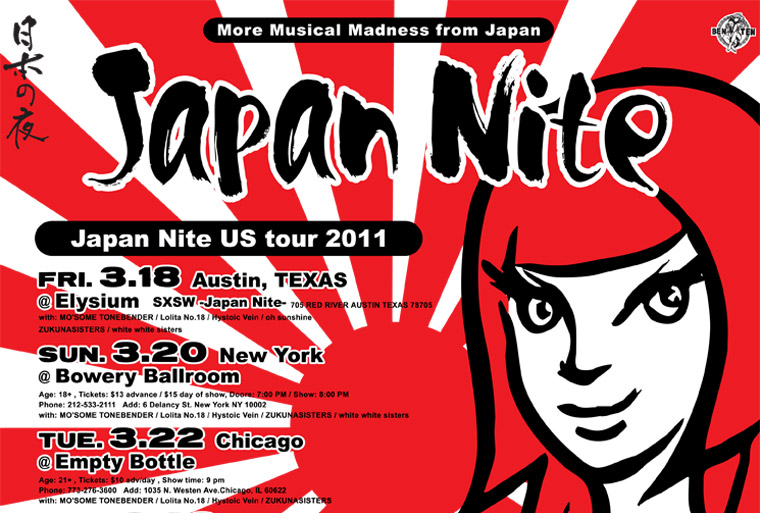
Chicagoans, check out Japan Nite IV tonight at the Empty Bottle, where 10% of the proceeds of the tour’s fourth annual US jaunt goes to the Red Cross to benefit the disaster in Japan.  The venue encourages all ticket buyers to separately donate $5 to the Red Cross; in exchange, each will receive a drink ticket for a domestic draft beer.

Catch the rest of the tour this week in Seattle, Las Vegas, Los Angeles, and San Francisco, and click “read more” to see the full flier.

Le Disquaire

Behind the Counter: Le Disquaire (Saint-Brieuc, France)

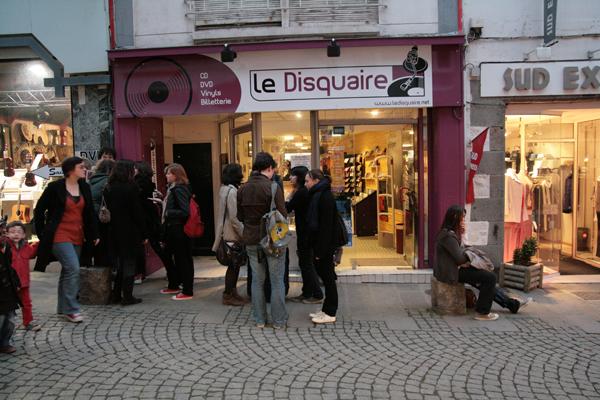
Saint-Brieuc is located on the northwestern tip of France, near the English Channel. Its most notable musical export is perhaps Julie Budet of electro-pop group Yelle. Saint-Brieuc is also home to a record store called Le Disquaire. It says something about the size of the town, and the closeness of the musical community, that these two entities call each other friends. We spoke with Gilles Ollivier of Le Disquaire and discovered that, despite the fact that it’s a small city, big acts regularly roll through town and play on the venue’s own stage.

What are the origins of Le Disquaire / What is your background in music?

When we opened in 2006, there was no independent record store in Saint-Brieuc anymore. We’ve grown up with such places (and we had been working for several years in that type of shop) where music may be something more than just a product. We wanted to share our passion and experience.

Le Disquaire

What does the store do particularly well — any specialty genres or formats?

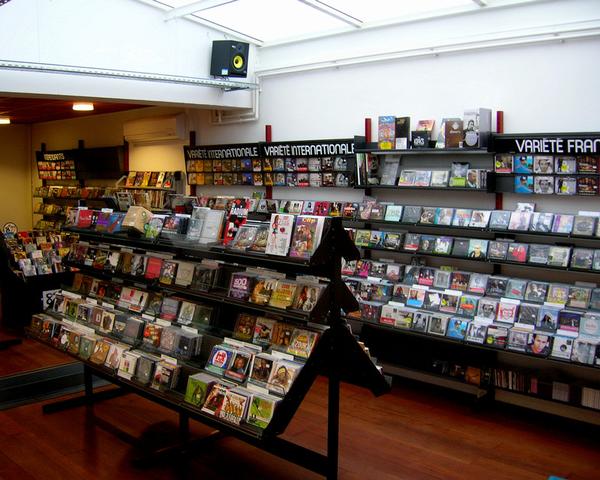
We sell all kinds of music and all formats (including lots of vinyl), which means having the artists that you don’t find anywhere else. That’s what make us different and that’s why we work with many labels and artists (mainly French for the moment).

Talib Kweli

Beats & Rhymes: Talib Kweli’s Gutter Rainbows

Each Monday, Beats & Rhymes highlights a new and notable hip-hop, rap, DJ, or electronic record that embraces independent sensibilities.

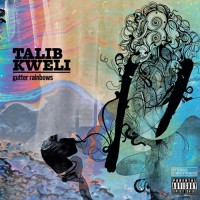
Talib Kweli: Gutter RainbowsTalib Kweli: Gutter Rainbows (Javotti Media, 1/25/11)

Talib Kweli: “Cold Rain”

[audio:https://alarm-magazine.com/wp-content/uploads/2011/03/talib_kweli__cold_rain.mp3|titles=Talib Kweli: “Cold Rain”]

There’s a certain sternness to Talib Kweli‘s rapping. It’s a constant in his music, and it makes you listen a little harder to differentiate where he’s going from song to song. He tends to give his work an intimidating surface, though at heart it’s accessible, unrestful, richly stimulating hip-hop, fiery in spirit and not prone to corny messages. Since the 1998 collaboration Mos Def and Talib Kweli are Black Star, he’s delivered his words with a bold shove forward.

Kweli doesn’t sound humbled or chastened on the new Gutter Rainbows, nor does the bass line that smoothly slams the bolts home on the title track. He says in the liner notes that “this is my second album (after Liberation) that the music industry did not help me create.” This fact cuts both ways. There’s a different producer on nearly every track, but nearly all of them (from M-Phazes to Oh No to Ski Beatz) somehow connect back to the warm instrumentation (flute, guitar, swirly soul vocals) of 88-Keys‘ intro track, “After The Rain.” It’s a busy and collaborative 14 tracks, but thoroughly solid.

Disappears

Guest Spots: Disappears explains its key components

Disappears: GuiderDisappears: Guider (Kranky, 1/17/11)

Disappears: “Halo”

[audio:https://alarm-magazine.com/wp-content/uploads/2011/03/Halo.mp3|titles=Disappears: “Halo”]

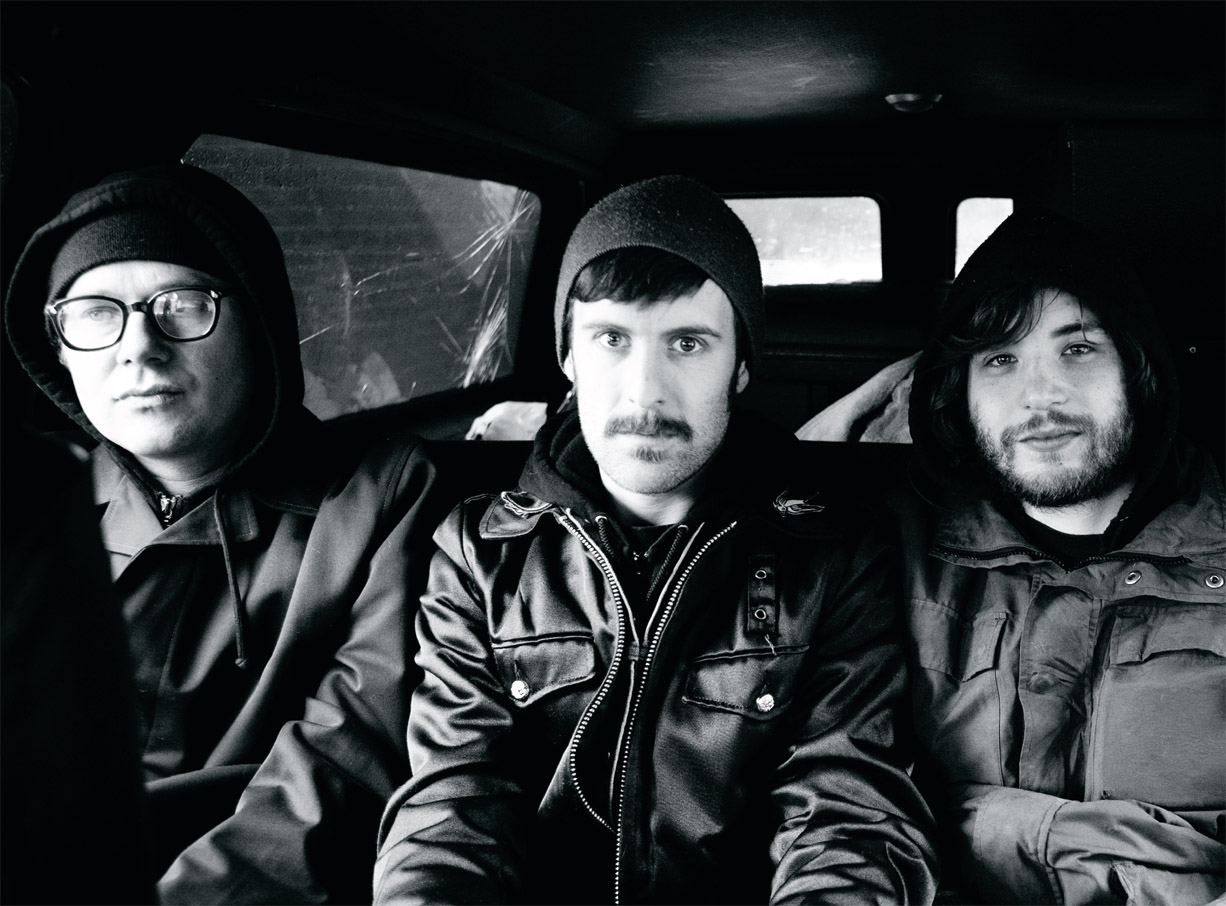
Chicago-based rock band Disappears feels pigeonholed. After having just released its second album, Guider, in January, the same words seem to keep popping up like shampoo instructions in various descriptions of its music: echo, fuzz, psych, kraut. The terms aren’t off base, but the band would like to think that it has a few different tricks up its sleeve. Here to address this limited vocabulary, vocalist Brian Case (formerly of The Ponys and 90 Day Men) breaks down the most recycled lingo while explaining the band’s key elements.

The Basic Elements of Disappears’ Music
by Disappears

Roland Space Echo

Used by everyone from King Tubby to KISS, the Roland Space Echo (specifically the RE-201) is a not-so-secret weapon for us. Every vocal track this band has ever recorded has been run through one of these — as well as every instruments on our recordings at one point or another. The RE-201 is a simple system in which a small loop of tape records an incoming signal and immediately plays the recorded sound back over a couple playback heads before being erased over by new incoming audio. Being an analog-tape effect, the results are usually unpredictable. It’s the cool sounds you hear on dub records and the crazy sci-fi sounds in Twilight Zone episodes. We try and tastefully split the difference, although I really want our next record to be super dubbed out, so we’ll see.

Baths

Concert Photos: Baths @ Subterranean (Chicago, IL)

LA-based producer Baths, a.k.a. Will Wiesenfeld, released his debut album, Cerulean, last year on Anticon, and has been touring tirelessly ever since. His setup is simple, and his crew minimal: a laptop, an MPC, and himself. He doesn’t need much to make the magic happen; mountains of synth, heavy hip-hop beats, and fragile falsetto comprise his sound.

On paper, it sounds like what every other “producer” with a decent home-recording system is making. However, rather than merely aiming to impress with flashy tricks, Baths manages to make it sound fresh with palpable sincerity. Contributing photographer Drew Reynolds snapped these shots at a recent stop at Subterranean in Chicago.

Baths

Cursed

Cursed: Enemies with the Industry

Though it broke up following a serious tour robbery, Ontario-based hardcore band Cursed delivered three albums of ferocious hardcore punk, the last of which contained a particularly pointed message for the music industry.