Morrow vs. Hajduch

Morrow vs. Hajduch: Faun Fables’ Light of a Vaster Dark

Scott Morrow is ALARM’s music editor. Patrick Hajduch is a very important lawyer. Each week they debate the merits of a different album.

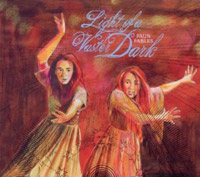
Faun Fables: Light of a Vaster DarkFaun Fables: Light of a Vaster Dark (Drag City, 11/16/10)

Faun Fables: “Light of a Vaster Dark”
[audio:https://alarm-magazine.com/wp-content/uploads/2011/01/Faun_Fables_Light_of_a_Vaster_Dark.mp3|titles=Faun Fables: “Light of a Vaster Dark”]

Morrow: Borne of principal songwriter Dawn McCarthy, Faun Fables is a powerful, somber, and multifaceted brand of neofolk songs and theatrical performance.  The group’s works also are developed by co-conspirator Nils Frykdahl of Sleepytime Gorilla Museum, and their breadth of instrumentation comes courtesy of assorted guests.

Light of a Vaster Dark is Faun Fables’ first album in four-and-a-half years, and it again is led by the dynamic vocal interplay of McCarthy, Frykdahl, and others — blending elements of the 1950s/’60s American folk revival, medieval and Celtic music, and the catchall “psychedelic folk.”

Though McCarthy’s clear intonation and wavering vibratos are the real star, Frykdahl’s backing vocals add a necessary baritone presence, and the album’s range of sounds is just as vital.  Guitars, violin, flute, bass clarinet, autoharp, Theremin, and homemade instruments all offer different sonic flavors behind a vocal presence that can sound a little homogenous from time to time.

Trap Them

ALARM Dispatches: Trap Them

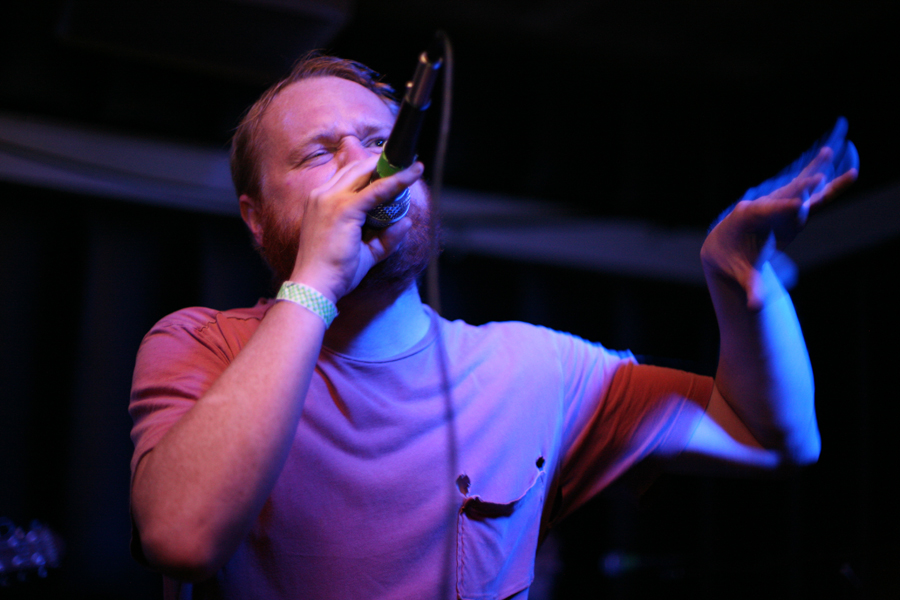
The brief window of time in which his band, Trap Them, plays a show affords Ryan McKenney the chance to lose himself in the moment and make art exactly the way he wants to.

Dan Deacon & So Percussion

Concert Photos: So Percussion & Dan Deacon @ Ecstatic Music Festival (NYC)

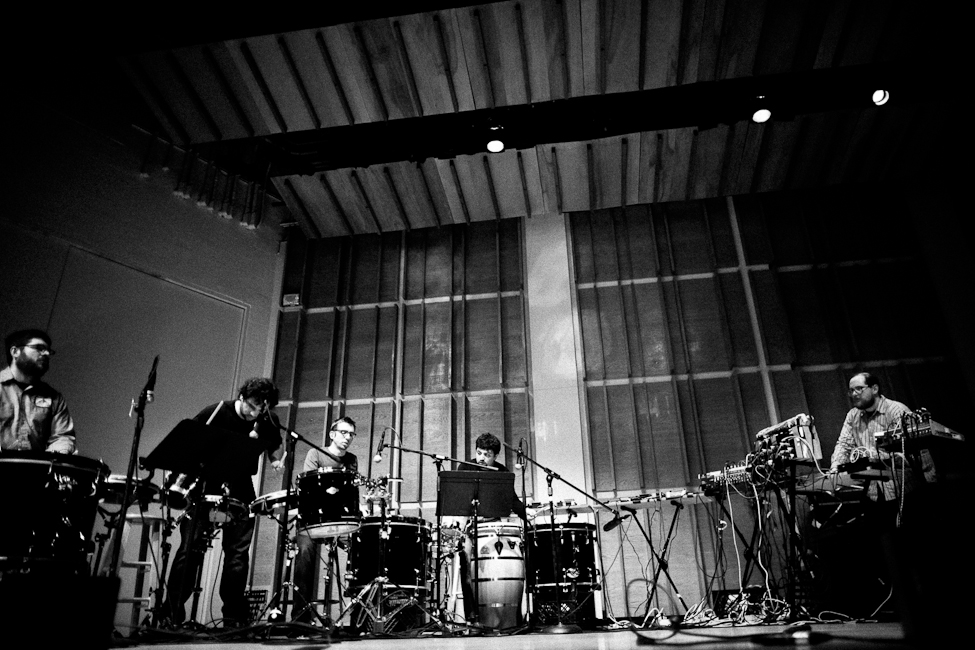
Electro solo act Dan Deacon recently reunited with his former Bromst tour-mate, experimental chamber quartet So Percussion, for a performance during the Ecstatic Music Festival at Merkin Concert Hall in New York City. Presented in association with New Amsterdam Records, the 15-concert, 150-band festival gathers performers, composers, and songwriters like Nico Muhly, Owen Pallett, and William Brittelle for two months of music and discussion.

Brooklyn-based photographer Eric Ryan Anderson attended the show and captured images of all of the bottle banging and knob twiddling that goes into some of the most progressive sounds around.

Dan Deacon & So Percussion

Gregory Jacobsen: "Explosion"

Posters & Packaging: Gregory Jacobsen

The work of Gregory Jacobsen depicts a slaughter. His work reveals the primal and wondrous parts of us, the parts just beneath the surface of our social mores fighting with our basest desires. These paintings lure as they terrify, inciting a reluctant humor.
 

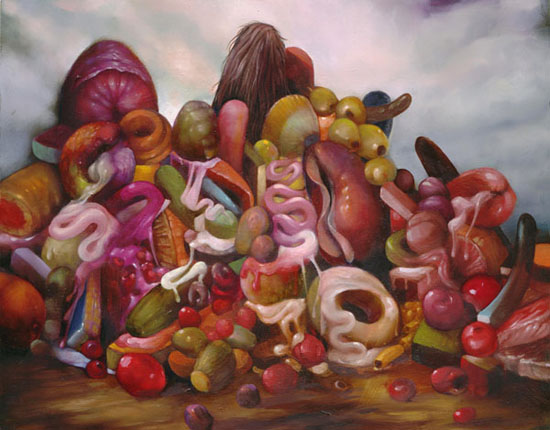
Gregory Jacobsen: Oozing Embankment
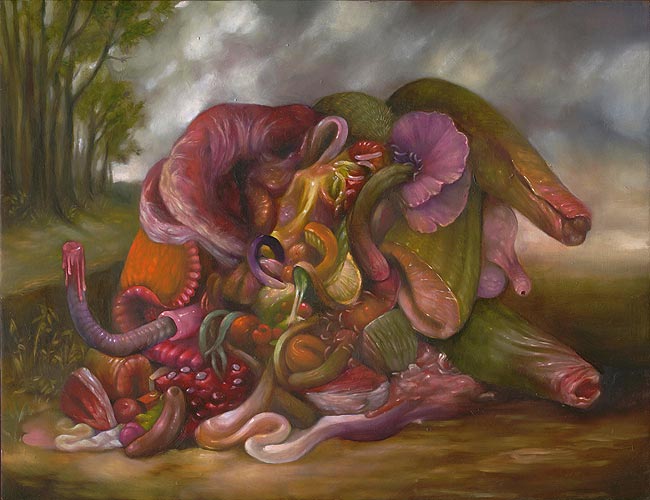
"Oozing Embankment" (oil on panel, 10 3/4" x 13 3/4", 2009)

Many of his paintings are still-life oil paintings gone mad. In “Oozing Embankment,” from 2009, it is as if there was once a less subversive still-life there, the fruits representing anticipated consumption. But tradition has been turned inside out, upside down, and left to show us what is really there: color, decay, and a natural, oozing beauty.

Jacobsen’s paintings and performances conjure conflicted feelings of terrorized fascination, a beauty in decay and gore, the truth of human existence. These moments originate from the underbelly of desire, terror, instincts for consumption, and compulsions toward what is odd and beautiful.

Jacobsen grew up in Middlesex, New Jersey. “A very strange place with an inferiority complex,” he says. “It’s New York’s little neighbor with fading mobster guys who are really always shit on and are considered second tier.” He says that New Jersey influences him; its inferiority complex causes him to look inward to evaluate himself, his body, and then outward to reveal similar truths about others.

Colin Stetson

Q&A: Colin Stetson

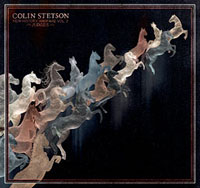
Colin Stetson: New History Warfare Vol. 2: JudgesColin Stetson: New History Warfare Vol. 2: Judges (Constellation, 2/22/11)

Colin Stetson: “Judges”

[audio:https://alarm-magazine.com/wp-content/uploads/2011/01/02-Judges.mp3|titles=Colin Stetson: “Judges”]

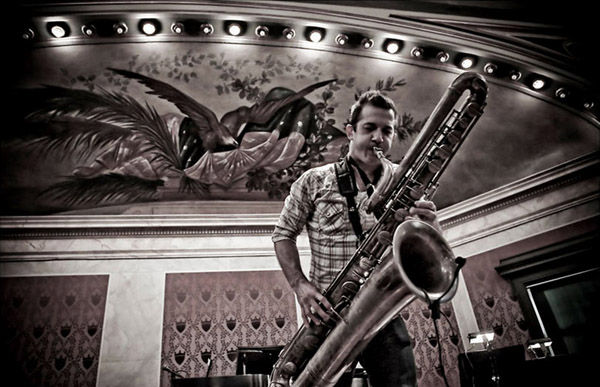
Powerful, otherworldly, and beautiful, wind player Colin Stetson‘s upcoming record, New History Warfare Vol. 2: Judges, commands attention from start to finish. Largely recorded live without overdubs, Stetson exploits techniques that yield dense layers of multiphonic sound that seem impossible to have come from a single instrument. Here sounding deep and sonorous as a foghorn, there alternating between percussive popping and plaintive moans, while elsewhere emitting swirling, cyclical lines that could nearly pass for strings, Stetson pushes his horns through every timbral possibility.

With such formidable instrumental prowess, one might expect a display of flashy improvisations, yet Stetson uses his command of his instruments in service of intricate compositions, rich in atmosphere and mood, and unmoored from any genre. Moreover, the pieces function together to create a coherent whole, emotionally resonant and deeply affecting.  A record that will sound arresting and fresh to even the most adventurous listeners, New History Warfare Vol. 2 (out on Feb. 22) is an early bright light among this new year’s releases and likely to resurface on many year-end lists.

Adept at bass sax, clarinet, bass clarinet, french horn, and cornet, Stetson studied music at the University of Michigan. From there, stints on both coasts resulted in work with a wide range of music luminaries, including Tom Waits, Anthony Braxton, Fred Frith, and Antibalas Afrobeat Orchestra. More recently, Stetson has startled unsuspecting rock audiences as an opener for stadium indie acts such as Arcade Fire and The National.  Here he explains how this integration of influences creates his own musical worlds.

When I’ve played your music for people, the unanimous reaction has been “that’s a sax?”, which is all the more impressive given that much of it was recorded without overdubbing. Can you explain how you’re able to create such a rich and diverse range of sounds, both in terms of technique and production?

Technically, regarding the instrument, I’m just employing a lot of extended techniques that improvisers have been using for decades. The basis for most of my pieces is in circular breathing; by breathing in through the nose and continuing to breath out of the mouth, you can create these longer, uninterrupted pieces of music. After that, it’s a lot of “voicing,” or using mouth and throat placement to form chords instead of single notes, specific arpeggiated lines to move those chords into individual and distinct melodies/harmonies, and also quite a bit of actual singing through the instrument.

Having been working this out for many years, when it came time to start recording this music, I knew that a straight-up stereo recording would only take a snapshot of what was happening, and would ultimately flatten the experience. There’s no way to capture the essence of live performance in this manner, not if the idea is to recreate the same image through recording. So what I try to do is to capture every distinct and separate element I can, individually with separate and different microphones, so that this information can then be reorganized in the mixing process, and, rather than an attempt at recreating the live experience, we create an alternate version of that experience, something that is specific to the process of recording. In simpler terms, I wanted to make a record like a Haruki Murakami novel or a Terrence Malick film.


The Groove Seeker: The Go! Team’s Rolling Blackouts

On a weekly basis, The Groove Seeker goes in search of killer grooves across rock, funk, hip hop, soul, electronic music, jazz, fusion, and more.

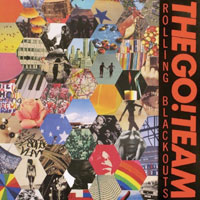
The Go! Team: Rolling Blackouts (Memphis Industries, 2/1/11)

The Go! Team: “The Running Range”

[audio:https://alarm-magazine.com/wp-content/uploads/2011/01/10-The-Running-Range.mp3|titles=The Go! Team: The Running Range]

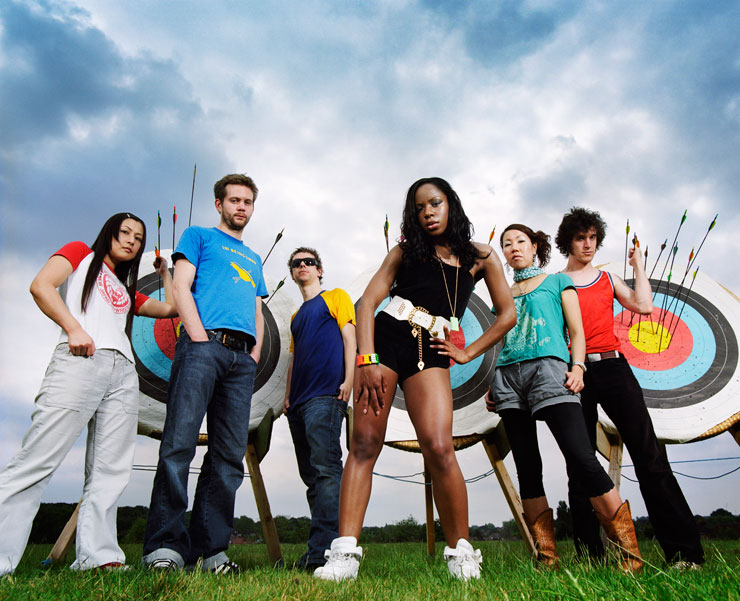
Originally Ian Parton’s solo home-brewed music project, The Go! Team became a six-member band upon the release of its debut, Thunder, Lightning, Strike, in 2004. As Parton put together a group to perform the music live, the pieces fell into place, and the band quickly became the highlight of international music festivals.

After running into copyright issues surrounding TLS’ samples, The Go! Team released Proof of Youth in 2007 — a sophomore-slump-dodging record that proved that Parton’s distinct patchwork funk pop was not a fluke. Four years later, the Brighton, England-based sextet is back with Rolling Blackouts, a rambunctious effort that leans toward ’60s-inspired pop. Building off its trusted template with a slew of guest vocals, including Best Coast’s Bethany Cosentino and Deerhoof’s Satomi Matsuzaki, the team’s upbeat blend of garage rock, hip hop, and noise pop sounds as refreshing at it did when Parton began.