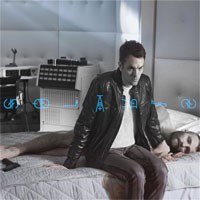
Ben Frost & Daniel Bjarnason

Q&A: Ben Frost & Daníel Bjarnason

Ben Frost & Daníel Bjarnason: SolarisBen Frost & Daníel Bjarnason: Sólaris (Bedroom Community, 11/8/11)

Ben Frost & Daníel Bjarnason: “Reyja”

[audio:https://alarm-magazine.com/wp-content/uploads/2011/11/Ben_Frost_Daniel_Bjarnason_Reyja.mp3|titles=Ben Frost & Daniel Bjarnason: “Reyja”]

Last year, Mat Schulz, who started Poland’s Unsound Festival, asked composers Ben Frost and Daníel Bjarnason — each residents of Reykjavík, Iceland — to rework Andre Tarkovsky’s 1972 film Sólaris. For both Frost and Bjarnason, their collaborative album Sólaris is a complete departure. Though Frost’s music is often labeled everything from dark industrial to classical minimalism, Bjarnason’s compositions are wildly extravagant yet controlled; together, it’s an inspired collaboration. Under their guidance, Sólaris achieves a delicate balance of the two personalities.

The soundtrack began as an improvisation played to the film. With the help of music software, these initial sketches were reproduced digitally and were then given to a 30-piece orchestra to replicate. Though far from the original score, what resulted was a sort of experiment between man, machine, and art, skillfully capturing the beautifully fragmented, tense, and at times haunting quality of the film.

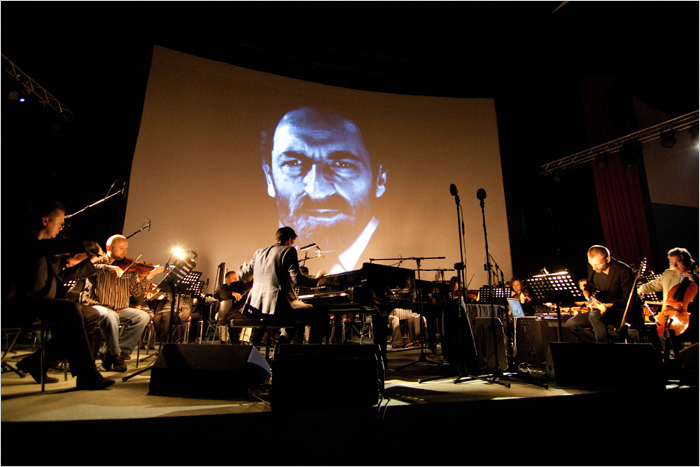
The piece has been performed — alongside stunning visual “film manipulations” by Brian Eno and Nick Robertson — with Sinfonietta Cracovia in Krakow and New York as well as Iceland and Austria.

In light of last month’s release of Sólaris, we spoke with Bjarnason about the concepts behind the album and the soundtrack’s transformation.

Why did you choose to remake the Sólaris soundtrack? In what ways did the original fall short of your expectations?

For me, the issue was never to make a new or better soundtrack to the Tarkovsky film. The piece is simply inspired by the film and the book. Stanislav Lem wrote Sólaris in Krakow, and it had its 50-year anniversary the same year as we premiered Sólaris in Krakow during the Unsound Festival, so it was a great way to mark that occasion.

Was this originally meant to be a literal soundtrack to the film? How did it evolve into what it is now?

That was the original idea, yes, but we were quick to abandon that idea. I think we were both much more interested in taking the film as a starting point and then moving on from there. So all the music was made during improvisation session where me and Ben watched the film and improvised on top of it and recorded what we did. So every musical moment is a response to a certain scene or moment in the film. But we never watched after those initial sessions, and when I listen to the piece now, I have no idea what music goes with what scene. In a way, we left the film behind at that point and just looked at what we had musically. Then the Sinfonietta came into the process, and the whole thing took on another dimension.

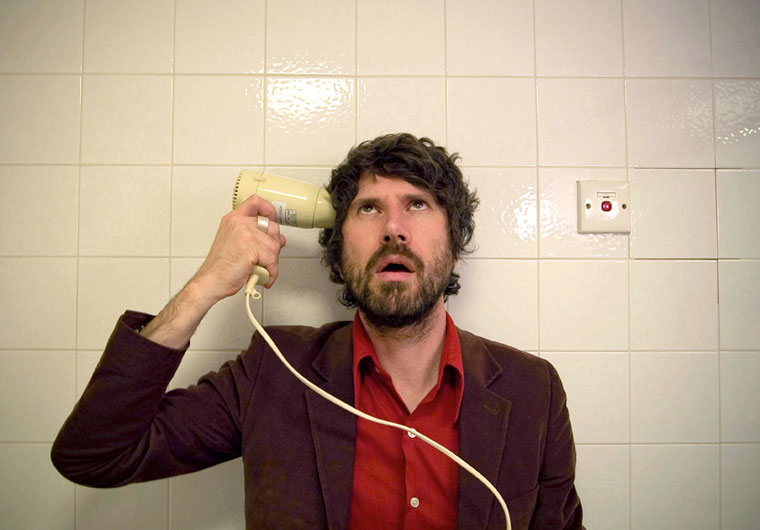
Gruff Rhys

Pop Addict: Gruff Rhys’ Atheist Xmas EP

Gruff Rhys

Every other Thursday, Pop Addict presents infectious tunes from contemporary musicians across indie rock, pop, folk, electronica, and more.

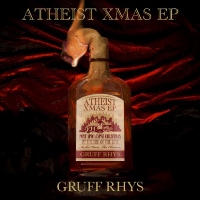
Gruff Rhys: Atheist Xmas EP Gruff Rhys: Atheist Xmas EP (Wichita, 12/20/11)

Gruff Rhys: “Slashed Wrists This Christmas”

Around this time of year, before the reality and harshness of winter set in, December is usually a time of good cheer and holiday festiveness. And now, thanks to Gruff Rhys, atheists can enjoy the season too. The Super Furry Animals front-man has just released a new EP called Atheist Xmas — a three-song offering featuring hook-heavy, head-bobbing catchiness — that is sure to help get you through to the coldest days this winter (or at least a few minutes of them at a time).

And don’t worry — this one isn’t sung in Welsh.

Zine Scene: The Toucan Magazine

The ToucanLiz Baudler & Laura Rynberg: The Toucan Magazine

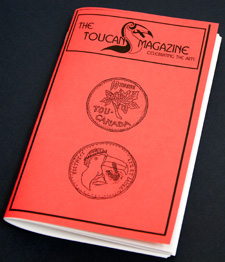
It seems that all we hear about these days is how much trouble the print-publishing industry is in. With many major publications moving online (or at least developing a much stronger online presence), it seems natural to worry that smaller (and less wealthy) works like zines are going to have to adapt or die off. The zine-like literary journal The Toucan is at least a partial proof that print volumes can survive (and maybe the Internet is their salvation).

I’ll admit that I have a soft spot for submissions-based literary magazines. It’s nice to think that in the digital age (and the increasingly conglomerate-based publishing industry of today) that some people are still painstakingly choosing and collecting short stories and poems from aspiring authors and publishing them in zine form. Printed work has a way of feeling more personal, and when your reading material contains a variety of poems and stories by mostly anonymous individuals, the personal touch can be crucial. The Toucan retains this touch of intimacy, but the quality and variety of work is especially surprising in this little unassuming volume.

Kenan Bell

Album Download: Kenan Bell’s Summer Solstice Vol. 3

Kenan Bell: Summer Solstice Vol. 3Kenan Bell: Summer Solstice Vol. 3 (12/21/11)

Kenan Bell: “Book of the Month (feat. Ayomari & Carl Roe)”

[audio:https://alarm-magazine.com/wp-content/uploads/2011/12/04-Book-Of-The-Month-featuring-Ayomari-Carl-Roe.mp3|titles=Kenan Bell: “Book of the Month (feat. Ayomari & Carl Roe)”]

Indie rapper Kenan Bell releases the third installment of his Summer Solstice mixtape series tomorrow, the summer solstice for the Southern hemisphere. On this collection, the former Montessori schoolteacher samples the likes of Caribou (“Caribou”), Lovage (“Book of the Month”), the Talking Heads (“Home”), and plenty more, layering his signature nerd rap over each and making them his own.

A day before its official release, ALARM presents an exclusive download of SSV3. (And if you haven’t already, be sure to download Summer Solstice Vol. 1 and Vol. 2.)

Bell also provided some commentary below for SSV3. We advise that you listen to it in its entirety while enjoying his behind-the-scenes notes.

Moses Supposes

Moses Supposes: Goodbye, Edgar; We Hardly Knew Ya

Moses Avalon is one of the nation’s leading music-business consultants and artists’-rights advocates and is the author of a top-selling music business reference, Confessions of a Record Producer. More of his articles can be found at www.mosesavalon.com.

Is the Bronfman exit the sign of great things to come in the record biz?

So Warner Music Group chairman Edgar Bronfman quit. Who cares? Well, I do, and so should you if you’re an artist or anyone who services one.

I never met Mr. Bronfman. The closest I came was to sit a table away from him at an awards function years ago, and here is the embarrassing part: I didn’t even know it was him.

Ed changed the music business, and though we could argue for another ten years as to whether he changed it for better or worse, the truth is that it’s now irrelevant, because it’s his departure and this particular time that has meaning. Now that the most significant (albeit not the largest) label, Warner, is in control and positioned to be the most influential distributor in the game, what is the Russian guy who bought it gonna do? He’s going to clean house as step one.

Ed didn’t just quit. He was fired. Not with a pink slip, but by the natural merger and acquisitions attrition of a golden parachute and planned obsolescence. If you didn’t see this coming, you’re not paying close enough attention to the recent music-biz math.

Phantogram

Q&A: Phantogram

Phantogram: NightlifePhantogram: Nightlife (Barsuk, 11/1/11)

Phantogram: “Don’t Move”

[audio:https://alarm-magazine.com/wp-content/uploads/2011/11/02-Dont-Move.mp3|titles=Phantogram: “Don’t Move”]

A few years ago, Josh Carter and Sarah Barthel took to recording their own music in a barn in upstate New York. Though it was never intended for the masses, the music made an auspicious debut via the 2010 album Eyelid Movies on Barsuk, and a loyal Phantogram following materialized — and continues to grow ever larger. In addition to praise from unexpected sources (Questlove, Big Boi, Fitz and the Tantrums, Kings of Leon), the duo’s popularity has risen from a years-long tour stint, loaded with sold-out shows, international bookings, and major festival appearances.

And in the midst of the tour hustle and bustle, Phantogram has managed to pull off yet another standout release in the form of Nightlife. Carter’s minimalist guitar lines, hip-hop beats, and assorted loops and samples weave the perfect melodic backing for Barthel’s breathy singing and, at times, his own reverb-laden vocals. The synths and drum-machine beats draw similarities to Eyelid Movies, but the new record holds its own as a mini-LP — and also holds fans over until the next full-length release.

Here, ALARM speaks with Carter about performing live, his collaboration with Barthel, and Nightlife.

What do you like about recording in a barn versus a recording studio?

It was circumstantial, really. We lived up in the country in upstate New York, and it’s what we had. My parents had a barn on their property, and I had been collecting a lot of recording equipment and learning how to record myself. Instead of having to pay a lot of money to go into a studio, we just did our first album ourselves, and the new record as well.

You have a long, diverse list of musical influences. What non-musical influences impact your songwriting?

Dreams definitely impact my lyric writing and our songwriting. Often when Sarah and I get together to work on music, we kind of come up with imaginary plots that would be in a movie. We think very visually when we’re writing.

What are your roles in songwriting?

I write the lyrics. I make the beats and I write most of the music, but often Sarah and I get together and write. Sometimes she’ll come up with something on the piano or guitar and bring it to the table, or I’ll make a beat or write something on guitar or piano, and we’ll bring it together.

Sometimes we just jam over a basic drum-machine rhythm and vamp for a few hours and write that way. Often when I write lyrics too, I’ll bounce them off Sarah and see what she thinks of it; so, sometimes even though she isn’t writing the lyrics, she’s connected to them anyway because she’s there while I’m writing them.